How Many Power Points Does a New Home Actually Need?
Building a new home is exciting, but it is easy to overlook one detail you will notice every single day: your power points. Get the number and placement right, and daily life feels effortless. Get it wrong, and you are reaching for double adaptors and running extension leads across the floor. So how many power points does a new home actually need? The honest answer is that it depends on how you live, though there are sensible benchmarks for every room. As Dunedin-based Master Electricians with extensive industry experience in new builds, we help Otago families plan power points that suit real life, not just the bare minimum.
Key Takeaways
- There is no fixed number; the right count reflects how your household actually lives.
- As a starting point: kitchens want generous double outlets along the bench, living areas three to four doubles, bedrooms at least three doubles, and a home office a quad outlet.
- New homes must meet the AS/NZS 3000:2018 wiring rules, with RCD protection on socket outlets and a Certificate of Compliance on completion.
- Adding outlets during the build is far cheaper than retrofitting, so plan now for EV charging, a home office and smart-home wiring.
Why Getting Your Power Points Right Matters
Adding power points during the build is straightforward and affordable. Adding them later means cutting into finished walls, patching, and repainting, which costs far more and creates mess. A new build is your one clear opportunity to place outlets exactly where you want them.
It pays to think through each room before the walls are lined. A little planning now saves years of frustration, keeps your home tidy, and helps everything run safely.
How Many Power Points Does a New Home Need, Room by Room
There is no universal rule, but the guidance below reflects how most households actually use each space. Treat these as a starting point, then adjust for your own routines and furniture layout.
Kitchen
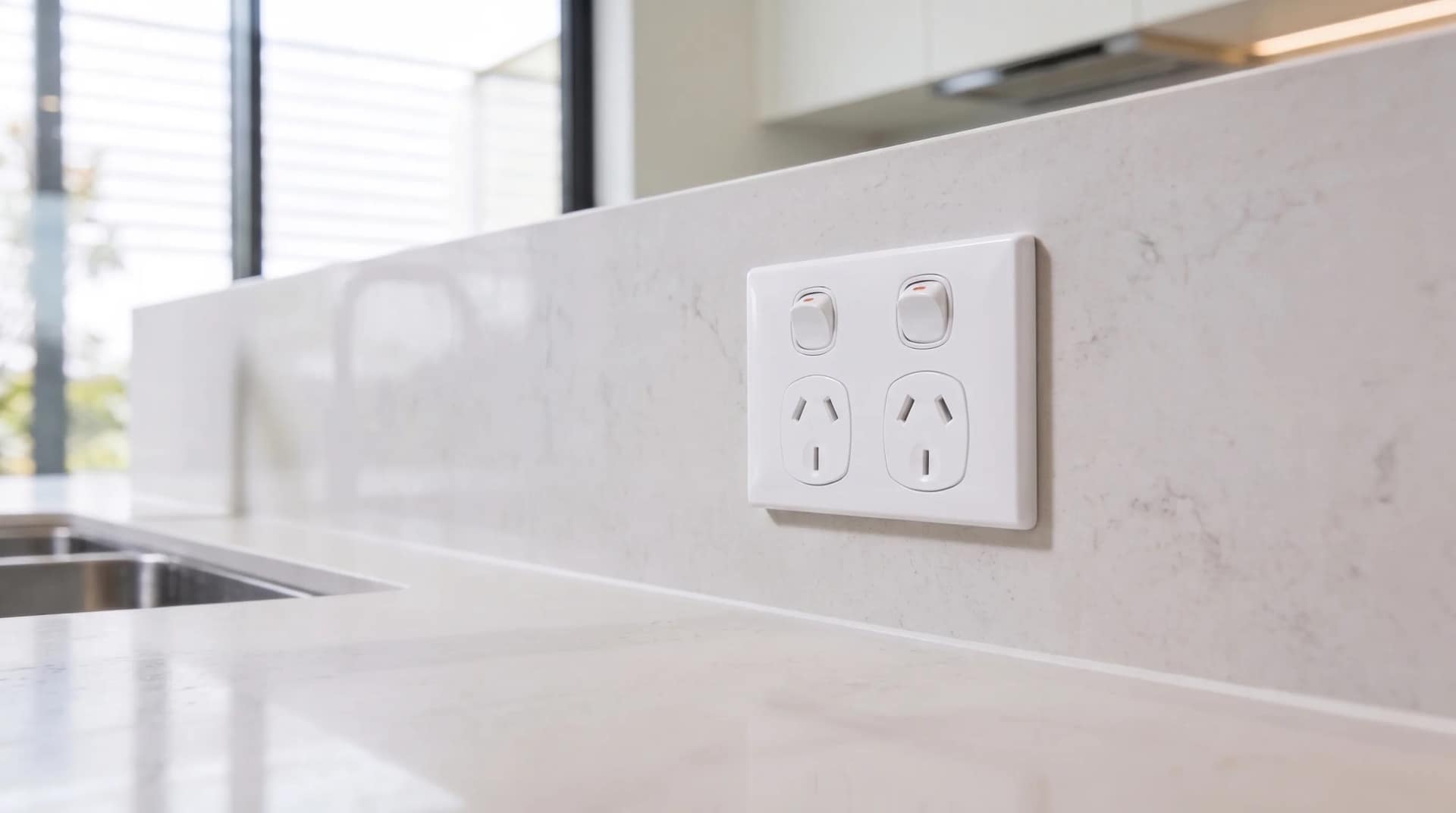
The kitchen is the busiest room for power in most homes. Think about the fridge, oven, microwave, kettle, toaster, and dishwasher, plus the growing list of bench appliances such as air fryers and coffee machines. We usually recommend generous double outlets along the bench at around 100mm above the surface, plus dedicated points for fixed appliances. Islands benefit from their own outlets, and pop-up or hidden sockets keep the look clean.
Living and Family Areas
Lounges need more power than people expect once you count the television, sound system, gaming console, modem, and phone chargers. Around three to four double power points spread across the room works well. Plan a low outlet behind the television and a separate point for your heat pump so everyday sockets stay free.
Bedrooms
For bedrooms, aim for at least three double power points. A double on each side of the bed at bedside height makes charging phones and running lamps easy, with another on the opposite wall for a heater, television, or vacuum. Built-in USB charging outlets are a popular addition that free up your standard sockets.
Home Office and Study
With more people working from home, a well-planned study is worth the effort. A computer, monitor, printer, modem, and desk lamp add up quickly. Quad outlets with built-in USB charging keep everything powered without a tangle of adaptors under the desk.
Laundry, Garage and Hallways
The laundry needs points for the washing machine and dryer, plus a spare for an iron or steamer. Garages are easy to leave under-wired, so allow for a freezer, power tools, and possibly an EV charger down the track. A handy outlet or two in hallways makes vacuuming and seasonal lighting simple.
Outdoor Areas
Outdoor living is part of the Kiwi lifestyle, so weatherproof outlets with the correct IP rating are a smart inclusion. They power the barbecue, outdoor heaters, garden lighting, and tools, and they save you running leads out through a window.
What the Wiring Rules Say
Under the Electricity (Safety) Regulations 2010, every new home in New Zealand must be wired to the AS/NZS 3000:2018 standard, and socket outlets need residual current device (RCD) protection to guard against electric shock. Once the work is finished, a registered electrician issues a Certificate of Compliance for the fixed wiring, which is your assurance that the job meets legal safety requirements.
This is not an area for shortcuts. Working with a Master Electrician means your new home is safe, compliant, and properly certified from day one.
Plan Ahead For How You Will Live
Technology in the home keeps growing, so it makes sense to plan for the next decade, not just moving in day. Consider a spot for an EV charger in the garage, extra outlets for a home office that may expand, and cabling for smart home features such as automated lighting and switches. If you are also weighing up solar, see our guide on how solar power works in NZ homes.
Adding a few more points during the build is inexpensive compared with retrofitting later. When in doubt, a couple of spare outlets per room is rarely regretted.
Get Your New Build Wiring Right From the Start
There is no single magic number, because the right layout reflects how your household actually lives. A good electrician will walk through your plans room by room, ask how you use each space, and design a layout that feels effortless. As a locally owned team serving Dunedin, Mosgiel, and the wider Otago region, we take the time to get this right the first time.
Our new-build wiring is designed around your plans and backed by the Master Electricians New Zealand workmanship guarantee, so the layout you sign off is the layout you get. As an EWRB registered team, we hand over every home with a Certificate of Compliance and a fixed price quote agreed before we start, so there are no surprises at the end.
Plan It Once, Enjoy It Every Day
Your power point layout is one of those details you will appreciate every day for the life of your home. Taking a little time to plan it during the build means no compromises later and a home that simply works around you.
Ready to plan your new build? Talk to the team at A1 Electrical about a power point layout that suits your lifestyle. Contact us today for a free, fixed price quote and enjoy a home that is wired for the way you live.