Running a business in Dunedin or across Otago comes with a long list of responsibilities, and your building’s electrical system sits near the top of that list. Commercial electrical faults are far more common than many business owners realise, and the consequences of ignoring early warning signs range from costly downtime to serious safety hazards.
As Master Electricians with decades of experience serving Otago, we have worked across retail stores, medical centres, schools, restaurants, and offices throughout the region. In that time, we have seen the same electrical faults appear again and again. The good news is that most of them are entirely preventable.
Here is what to watch for, and what you can do about it.
1. Overloaded Circuits
One of the most frequent issues we encounter in commercial premises is circuits that are simply doing too much. Businesses grow, new equipment arrives, and the electrical system that was adequate five years ago is now struggling to cope.
Overloaded circuits cause breakers to trip repeatedly, generate heat in cabling, and in serious cases create a fire risk. If your team is regularly resetting tripped breakers or relying on extension leads across the workspace, that is a clear signal that your electrical capacity needs reviewing.
How to Prevent It
Schedule a professional electrical inspection to assess whether your current circuit configuration matches your actual load requirements. A registered electrician can add dedicated circuits for high-draw equipment such as air conditioning systems, commercial refrigeration, or server infrastructure. Spreading the load correctly protects your equipment and your team.
2. Outdated or Faulty Switchboards
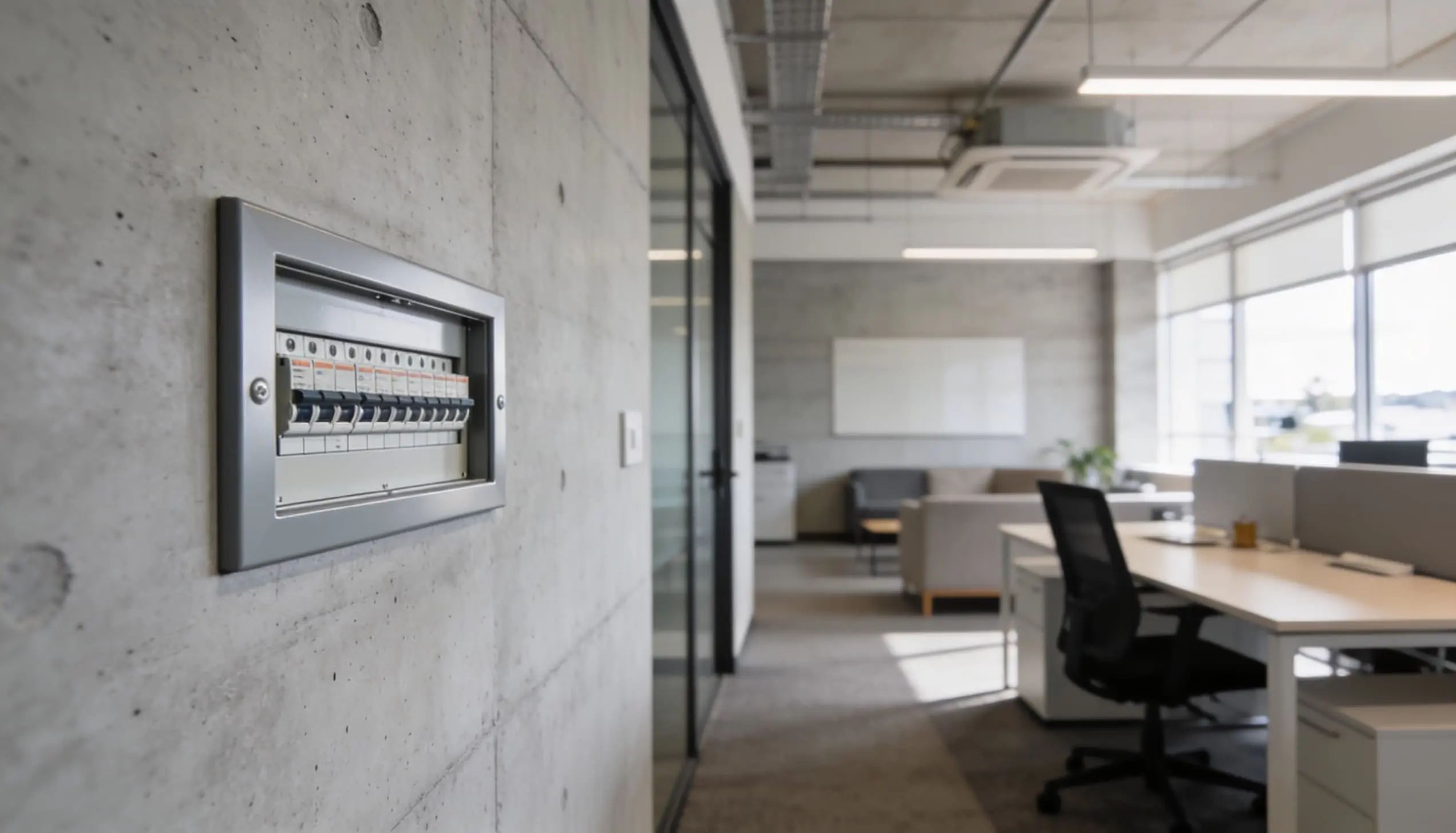
Many commercial buildings in Dunedin still operate with switchboards that were installed well before today’s electrical demands were imagined. Older fuse-based boards cannot respond quickly enough to protect modern wiring and appliances, and they often lack residual current devices (RCDs) that are now standard under New Zealand’s AS/NZS 3000:2018 wiring rules.
Signs of a switchboard that needs attention include visible scorch marks, a burning smell near the board, fuses that fail regularly, or a panel that is warm to the touch. These are not minor inconveniences. They are warnings. For residential homes, see the signs your switchboard needs an upgrade.
How to Prevent It
Upgrading to a modern switchboard with proper RCD and circuit breaker protection is one of the most cost-effective investments a commercial property owner can make. At A1 Electrical, we install trusted Schneider and Vynco switchboards and issue a Certificate of Compliance on every job, giving you documented proof that the work meets current New Zealand standards.
3. Deteriorating or Incorrectly Installed Wiring
Wiring does not last forever. In older commercial buildings, insulation around cables degrades over time, particularly in environments with temperature variation or where cables run through walls that have been modified during renovations. Rodent damage is another factor that often goes unnoticed until a fault develops.
Incorrectly installed wiring is a different problem altogether. Work carried out by unregistered tradespeople or without proper certification can leave circuits that are not earthed correctly, cable sizes that do not match the load, or connections that were never properly secured. In New Zealand, most fixed wiring must be done by a registered electrician — our article on when to call a licensed electrician outlines the rules and safe DIY limits.
How to Prevent It
Any time you are planning a renovation, fitout, or alteration to your commercial space, engage an EWRB-registered electrician from the start. At A1 Electrical, all wiring work is carried out to AS/NZS 3000:2018 standard with a Certificate of Compliance issued on completion. If you are concerned about existing wiring, an electrical inspection will give you a clear picture of what needs attention.
4. Inadequate Lighting Systems
Poor lighting is often treated as a minor inconvenience, but it carries real risks in a commercial setting. Insufficient lighting in storage areas, stairwells, or workspaces creates hazardous conditions for staff and visitors. Lights that flicker or fail repeatedly often indicate a wiring fault, a failing fitting, or an overloaded circuit rather than simply a globe that needs replacing.
Beyond safety, outdated lighting systems also cost businesses more than they should. Older fluorescent systems consume significantly more energy than modern LED alternatives, and the difference in running costs adds up quickly across a full commercial fitout.
How to Prevent It
A lighting assessment as part of a broader electrical inspection can identify both safety issues and efficiency improvements. Upgrading to a well-designed LED lighting system reduces energy costs, improves workplace comfort, and removes the ongoing maintenance burden of frequently failing fittings.
5. Missing or Insufficient RCD Protection
Residual current devices (RCDs) are designed to cut power within milliseconds when they detect a leakage current that could cause electric shock. They are a critical safety layer in any commercial environment, particularly in areas where water is present such as commercial kitchens, bathrooms, and outdoor work areas.
WorkSafe New Zealand is clear about the importance of RCD protection in workplaces, and many commercial premises we inspect are either missing RCDs entirely or have them fitted to only some circuits.
How to Prevent It
Have an EWRB-registered electrician review your switchboard and circuit protection. Full RCD coverage is not just best practice. It is a key requirement under the Health and Safety at Work Act 2015 for employers who have a duty to manage electrical risks. A1 Electrical carries out compliance checks and switchboard upgrades across Dunedin and Otago, and we will give you a straightforward assessment of where you stand.
6. Unauthorised or Non-Compliant Electrical Work
This is unfortunately common, particularly after a business changes hands or following a renovation where shortcuts were taken. Electrical work carried out without a Certificate of Compliance (COC) is both a legal issue and a practical risk. It means the installation has not been inspected or verified, and you have no way of confirming it meets the standard required under New Zealand law.
Non-compliant electrical work can also affect insurance claims in the event of a fire or electrical incident, leaving the property owner or business operator exposed.
How to Prevent It
Always request a Certificate of Compliance for any fixed wiring work. If you have purchased a commercial property or taken over a tenancy and are uncertain about the history of the electrical installation, commission an independent electrical inspection. A written report from a Master Electrician gives you clarity, identifies any risks, and creates a clear record for insurance, sale, or lease purposes.
7. Poor Power Distribution Planning
Commercial premises with growing operations often find that power outlets are in the wrong places, circuits are shared between areas they should not be, or the load across the building is distributed unevenly. This leads to localised overloading, inconvenient workarounds with extension leads, and reduced efficiency across day-to-day operations.
How to Prevent It
When planning a new commercial fitout or a significant renovation, work with a commercial electrician who will assess your power distribution requirements and design a system that supports your business both now and as it grows. A1 Electrical has delivered commercial fitouts for businesses across retail, hospitality, medical, and education sectors throughout Otago, and we bring that practical experience to every new project.
The Value of Regular Electrical Inspections
Many of the faults described above develop gradually and go unnoticed until they cause a problem. A scheduled electrical inspection is the most effective way to catch issues early, maintain compliance with New Zealand standards, and give you confidence that your premises are safe for your team and your customers.
A1 Electrical provides detailed electrical inspection reports for commercial premises across Dunedin, Mosgiel, and the wider Otago region. Our reports are written in plain language and tell you exactly what was found, the risk level of each issue, and what remedial work is recommended.
We are EWRB-registered, Gold SiteWise Certified two years running, and members of Master Electricians New Zealand. Every piece of fixed wiring work we carry out includes a Certificate of Compliance as required under New Zealand law.